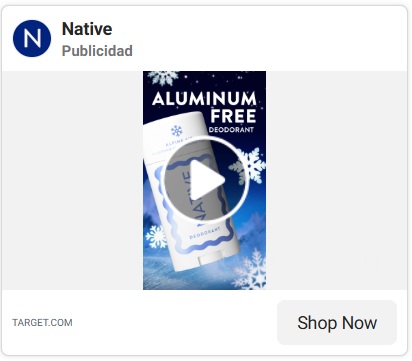
Native Meta Ads
Main Objective:
To profitably increase sales for Native deodorants in the United States using Meta Ads.
Campaign Structure:
Campaign: Sales
- Justification: A campaign with 3 ad groups. Advantage+ (to see how well the meta algorithm performs and to obtain data), another group with detailed targeting (an audience that might like our product and that serves as a comparison with the Advantage+ results) and a lookalike audience (people who have already bought)
- Campaign Objective: Sales
- Budget Setup: 70% of total budget. Advantage Campaign Budget.
Ad groups: Advantage+, granular targeting, and lookalike audiences (when data is available):
- Conversion Location: Website
- Conversion Event: Purchase
- Performance Goal: Maximize number of conversions
- Audiences: Advantage+, another ad group with detailed targeting according to our product, and when we have data from those 2 campaigns, we can create a lookalike audience.
- Ad Creatives:
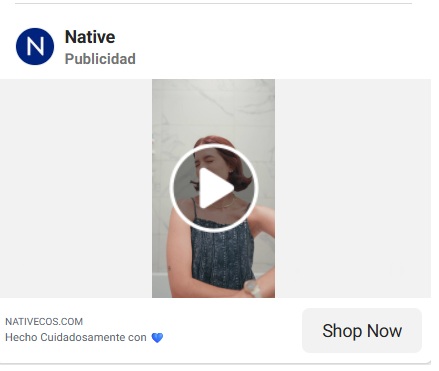
- 1.- Short-Form Video (UGC Style): A fast-paced, authentic video (Reel format) showing an active person using Native, highlighting its efficacy against odor («the 12-hour test») and its natural ingredients.
- 2.- Product Range Carousel: A clean, aesthetic carousel. Each card showcases a different scent (e.g., Coconut & Vanilla, Cucumber & Mint). The headlines focus on key benefits («Aluminum-Free,» «Vegan,» «Plastic-Free»).
- 3.- Explainer / Problem-Solution Video: A video that directly addresses the main customer objection: «Do natural deodorants actually work?» It explains why Native is effective and superior to conventional deodorants.
- 4.- Social Proof Ad (Static or Video):A screenshot of a 5-star customer review or a short user-generated clip. Text overlay: «Over 50,000 5-Star Reviews. Find out why.»
- 5.- Introductory Offer Ad: A simple, bold creative with a clear Call-to-Action (CTA) and a compelling offer to drive trial (e.g., «Build Your Starter Kit» or «Free Shipping On Your First Order»).
Campaign: Sales (retargeting or people who were close to buying)
- Justification: This campaign is designed to convert high-intent users who are close to purchasing (e.g., have added to cart or initiated checkout) but have not yet completed their order.
- Campaign Objective: Sales.
- Budget Setup: 30% of total budget. Advantage Campaign Budget.
Custom public ad groups (people who have already purchased):
- Conversion Location: Website
- Performance Goal: Maximize number of conversions
- Conversion Event: Purchase
- Audience: Custom Audience (Combined).- People who «Added to Cart» (Last 14 Days) and People who «Initiated Checkout» (Last 14 Days). Exclude.- «Purchasers» (Last 180 Days)
- Ad Creatives:
- 1.- Discount & Urgency Video:“Don’t miss out! Your cart is waiting. Get 10% off when you complete your purchase today.»
- 2.- Dynamic Product Ads (DPA) Carousel: A dynamic carousel automatically showing the exact products the user viewed or added to their cart.
- 3.- Ease & Urgency Ad (Static or Video): A simple creative reinforcing the ease of purchase and a direct call-to-action.
To complement this acquisition and retargeting structure, I also recommend a separate, always-on Customer Retention campaign.
Audience: «Past Purchasers» (e.g., last 180 days).
Objective: This audience should be targeted for new product launches, cross-sells (e.g., «Try our new body wash»), or subscription offers.
Justification: It is significantly more cost-effective to generate a repeat purchase from an existing customer who already trusts the brand than to acquire a new one. This campaign will focus on increasing Lifetime Value (LTV).
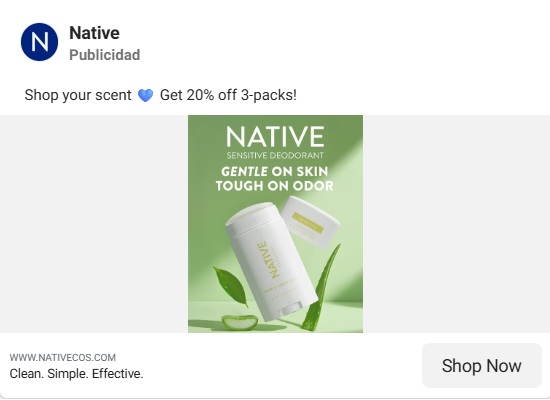
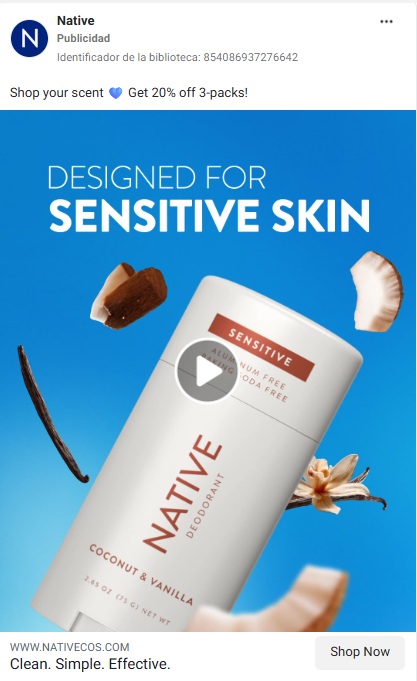
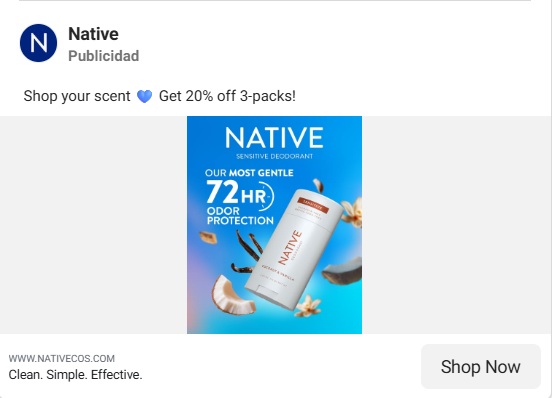
Ads example